eceiving a permit correction notice can feel like something has gone seriously wrong with your project. In most cases, however, it means the reviewing authority needs changes, additional information, or clarification before the permit process can continue.
At SitePlan California, we have seen firsthand that property owners often lose time because they react to individual comments without first understanding the entire notice. The better approach is to identify what the reviewer is asking, determine who should address each item, and prepare one coordinated response.
What Does a Permit Correction Notice Mean?
During permit review, the city or county examines the submitted drawings and supporting documents against the requirements that apply to the project. If the reviewer cannot confirm compliance from the information provided, corrections may be issued.
La Cañada Flintridge, for example, explains that plans are routed to the applicable departments for review. When corrections are required, correction letters and plans are returned to the applicant as part of a resubmittal package. The applicant addresses the comments and resubmits until the applicable departments approve the plans.
A correction therefore does not automatically mean that the project is prohibited. It can simply mean that the reviewer needs better documentation before making a decision.
The comments may relate to dimensions, zoning, site conditions, structural information, energy requirements, utilities, accessibility, fire requirements, or another part of the permit package.
What Information Can the Notice Include?
Correction comments can range from a simple labeling issue to a request that materially affects the proposed design. Understanding the type of correction is important before anyone begins changing drawings.
A notice may ask for:
- Missing setback or property dimensions
- Additional notes, labels, or construction information
- Revised drawings that resolve conflicting information
- Easement, zoning, or property clarification
- Structural, survey, energy, drainage, or other professional documentation
Several comments can also be connected. A request for a setback dimension may lead to questions about the property boundary. A boundary question may then affect the proposed building location.
This is why we recommend reading all comments together rather than treating each line as an unrelated task.
First Understand Whether It Is a Plan Review or Inspection Correction
Not every correction notice is issued at the same stage.
A plan review correction is generally issued before permit approval while the submitted drawings are being checked.
An inspection correction occurs after permitted construction has started and an inspector identifies work that needs to be corrected before the relevant inspection can pass.
The City of Ione, for example, explains that when permitted work does not pass an inspection, the inspector issues a correction notice and the work must be corrected before another inspection is scheduled.
These situations require different responses.
If your issue relates to submitted plans, you are generally dealing with plan revisions and resubmittal.
If the notice was issued during construction, you may need to correct field work and coordinate with the inspector, contractor, or appropriate design professional.
For this article, our main focus is correction comments associated with permit drawings and site plans.
Read Every Comment Before Revising Anything
Do not immediately open the plans and start making changes after reading the first comment. Read the entire correction package before beginning revisions. One revision can affect several drawings.
Imagine the reviewer says that a detached garage must move because the submitted setback information is inadequate. Moving that garage can change the site plan, driveway relationship, electrical routing, structural documents, and other sheets.
If one person updates the site plan while everyone else continues using the old garage location, the resubmitted package becomes inconsistent. I always advise clients to organize the corrections before drafting begins.
Determine which comments are related to the site plan, which affect architectural or structural documents, and which require another qualified professional. That preparation creates a cleaner response.
Do Not Assume Every Correction Belongs to the Drafter
Permit packages can involve several disciplines. SitePlan California may be able to address a correction involving the site drawing, such as missing dimensions, structure placement, labels, or available site information.
A comment asking for professional structural calculations is different. So is a request requiring a licensed land surveyor to establish a boundary. Other comments could involve architectural design, grading, drainage engineering, electrical systems, energy compliance, or another specialized service.
A trustworthy response requires knowing when the appropriate professional should become involved. Trying to solve every comment through site plan drafting can create inaccurate or incomplete documentation.
The purpose should be to answer the reviewer correctly, not merely to remove comments from a list.
Real World Scenario: One Comment That Changed the Site Plan
Consider a homeowner applying for a detached garage permit. The first submitted site plan shows the proposed garage near the rear property line. The reviewer issues a correction requesting clearer setback dimensions and information about an easement shown in the property records.
At first, the homeowner thinks the solution is simple: add the missing setback number and resubmit. But the easement comment changes the situation.
The available property documents are reviewed again, and the proposed garage appears to overlap the easement area. Simply adding another dimension would not answer the real issue. The homeowner now needs to understand the easement and determine whether the garage location should change.
The garage is moved to another part of the property. The revised site plan shows the new location and updated dimensions. This is why a permit correction notice should be interpreted rather than mechanically edited. The reviewer was not only requesting another number. The comments were identifying a site condition that affected the proposed design.
How Should You Respond to the Corrections?
Once every comment has been reviewed, create a coordinated revision process.
A good workflow is:
- Match each comment with the drawing or document it affects
- Make the requested revision or provide the required clarification
- Identify where the change appears in the revised package
- Review related sheets for consistency
- Confirm that every applicable comment has been addressed before resubmission
La Cañada Flintridge’s current process provides applicants with correction letters and a resubmittal checklist identifying documents required for the next submission. The review and correction cycle continues as necessary until the applicable departments approve the plans.
Follow the specific process provided by your jurisdiction.
California cities and counties can use different portals, file naming standards, response forms, and resubmittal procedures.
Why You Should Avoid Partial Corrections
Property owners often want to resubmit as quickly as possible.Speed is useful only when the response is complete.
If ten applicable comments were issued and only eight were properly addressed, another review cycle may be necessary.
Additional corrections can also appear when one change creates inconsistency elsewhere in the plans.
For example, changing an addition from twelve feet deep to ten feet on the site plan without updating the floor plan creates conflicting dimensions.Now the reviewer has another problem to resolve.
At SitePlan California, we prioritize coordination because the permit set should communicate one version of the project.A fast but inconsistent resubmittal can ultimately take longer.
What If You Disagree With a Correction?
Do not simply ignore it. If a reviewer comment appears unclear or you believe information has already been provided, first determine exactly what the reviewer is asking. The issue may not be that the information is completely absent.
It may be difficult to find, poorly labeled, inconsistent with another sheet, or insufficient for the reviewer to verify compliance. Sometimes clarification with the building or planning department is appropriate.
A clear written response can also point the reviewer to the relevant information. The goal should be resolution. Arguing with a comment without understanding the underlying concern rarely moves the project forward.
I prioritize a strategy where the technical issue is identified first and the response is prepared around that issue.
Can Corrections Increase the Cost or Timeline?
Yes.A correction that requires a small note revision may have little impact.A correction requiring a structure to move can affect several drawings and potentially require redesign.
Repeated review cycles can also increase project time, and some jurisdictions may charge additional plan check fees after multiple reviews. La Cañada Flintridge currently states that plan reviews exceeding three reviews are subject to additional plan check fees.
This is another reason the first resubmittal should be treated seriously.Complete responses cannot guarantee approval, but they can reduce avoidable repeated comments.
Keep the Correction Notice With Your Project Records
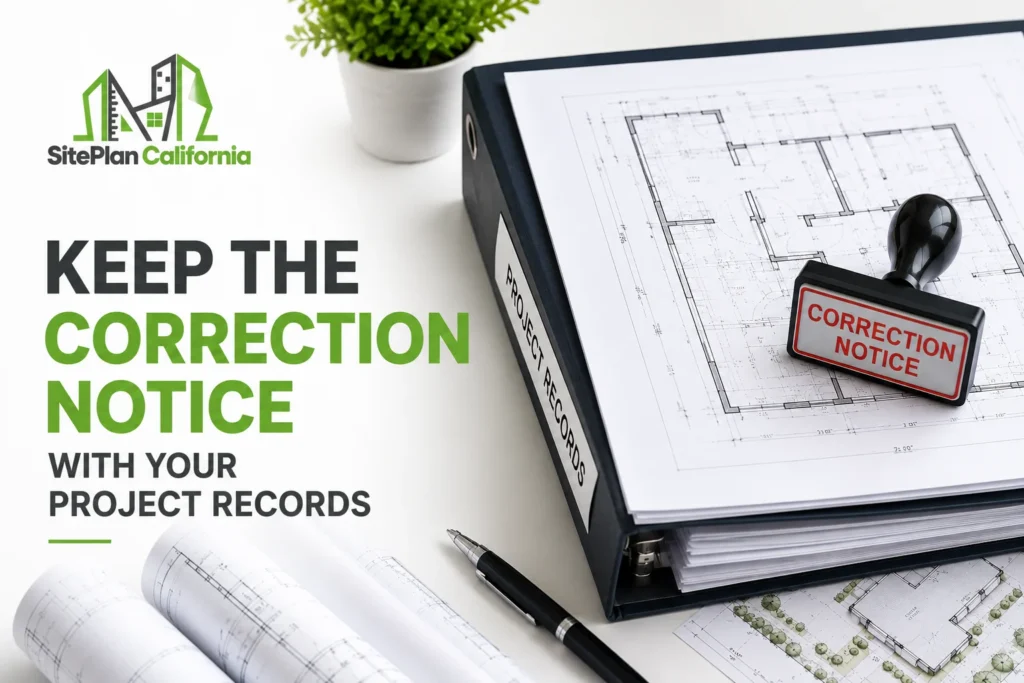
Do not delete the notice after the revised plans are submitted.
Keep the original comments, response documents, revised plan set, and any communication with the reviewing department together.
This creates a useful record of the project.If another correction cycle occurs, you can see what was previously requested and how it was addressed.
It also helps prevent old drawings from being confused with the latest version.For projects involving several professionals, version control becomes especially important.
The contractor, designer, engineer, drafter, and property owner should not be working from different versions of the project.
Why Choose Us for California Site Plan Corrections?
At SitePlan California, we focus on the site plan comments that fall within our drafting scope and help make the revised property information clear for the next review.
- We review the complete correction document before making site plan revisions
- We identify which reviewer comments affect the site drawing
- We update relevant dimensions, structures, labels, and proposed conditions
- We can work with existing property documents and reviewer comments
- We explain when surveying, engineering, architecture, or another professional service is required
Frequently Asked Questions
Does a correction notice mean my building permit was rejected?
Not necessarily. It commonly means the reviewer needs revisions or additional information before the permit review can continue.
How quickly should I respond?
Review the comments as soon as practical, but prioritize a complete response over a rushed one. The required time also depends on how extensive the revisions are and whether other professionals need to become involved.
Should I send my drafting provider the entire notice?
Yes. Send the complete document rather than cropped comments. Other comments can provide important context for the site plan revisions.
Can I change my project while making corrections?
You can revise the project, but significant changes should be coordinated across all affected drawings and may trigger additional review.
Can SitePlan California guarantee approval after corrections?
No. Permit approval remains with the reviewing jurisdiction. We can address comments that fall within our drafting scope and prepare clearer revised site documentation.
Conclusion
A permit correction notice is best treated as a set of instructions for improving or clarifying your permit package, not as an automatic project failure. Read every comment, identify the correct professional for each issue, coordinate affected drawings, and respond completely. SitePlan California focuses on making site plan corrections clear and consistent so the next review begins with better information