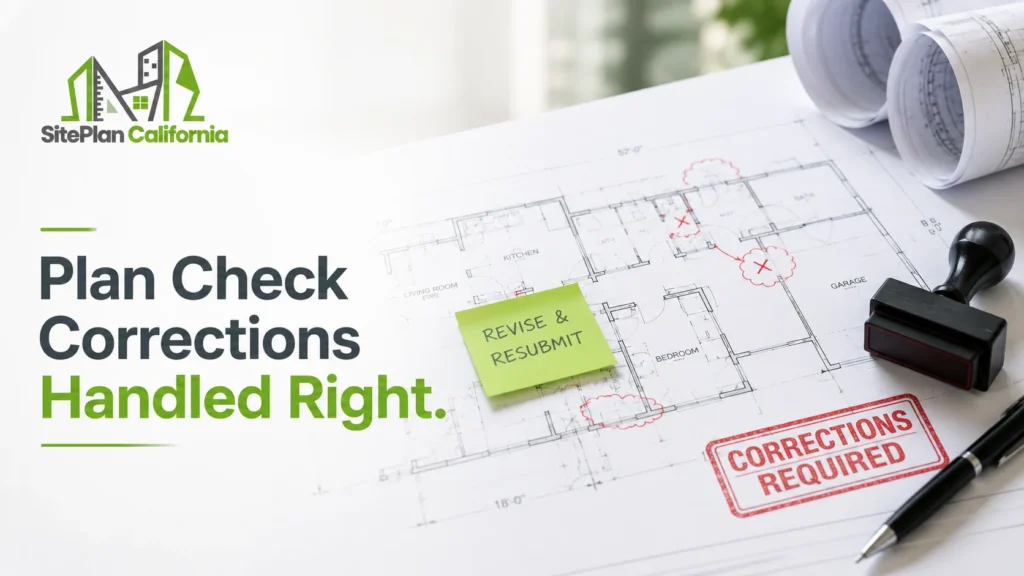
Receiving permit comments does not mean your project has failed. In many California jurisdictions, plan check corrections are a normal part of the permit review process. They usually mean the reviewer needs additional information, clarification, revised dimensions, supporting documents, or changes before the application can move toward approval.
At SitePlan California, we have seen firsthand that the quality of the resubmittal matters just as much as the original submission. A rushed response that fixes only part of the correction list can lead to another review cycle. A clear, complete, and organized response gives the reviewer a much better path to verify the changes.
What Are Plan Check Corrections?
Plan check corrections are comments issued by a reviewing department after examining submitted permit documents. The reviewer compares the plans and supporting materials against applicable building codes, zoning requirements, local ordinances, and project specific standards. If something is missing, inconsistent, unclear, or does not demonstrate compliance, a correction may be issued.
Corrections can involve the site plan, architectural drawings, structural information, energy documentation, electrical plans, plumbing, mechanical work, planning requirements, or other disciplines. Sacramento explains that plan reviewers evaluate plans and supporting files for compliance with applicable federal, state, and city requirements, including items such as setbacks and building height.
The purpose of the correction notice is to tell the applicant what needs additional attention before the review can continue.
Read the Entire Correction Notice Before Making Changes
One of the biggest mistakes is beginning revisions after reading only the first few comments. The complete correction notice should be reviewed before any drawing is changed because several comments may be connected.
For example, one comment may request the proposed setback dimension. Another may ask for clarification of the property line. A third may require the site plan and floor plan to show matching dimensions. Solving only the first comment could leave the larger issue unresolved.
I always advise clients to read the entire correction package first and organize the comments by discipline. This makes it easier to identify which items affect the site plan, which require another professional, and which changes could influence multiple sheets.
Create a Clear Response to Every Comment
A strong resubmittal should make it easy for the reviewer to find each correction.
The City of Ontario’s current residential correction instructions require applicants to correct the original drawings, identify revisions, and indicate the sheet and detail or note where each correction was addressed. It also requires changes that are unrelated to the correction comments to be identified separately.
A good response process should include:
- Address every correction individually
- State where the change was made
- Identify the relevant sheet or detail
- Explain the response clearly when additional context is necessary
- Do not mark an item complete unless the drawing actually reflects the change
A response such as “corrected” is less useful than a response that tells the reviewer exactly where the correction can be found.
The goal is to reduce the amount of searching the reviewer has to do.
Update All Affected Drawings, Not Just One Sheet
Permit drawings work together. A correction made on one sheet can create a conflict elsewhere if the entire plan set is not reviewed.
Suppose the building department requests that an addition be reduced from 14 feet to 12 feet because of a setback issue. The site plan is revised, but the floor plan still shows the original 14 foot addition. The elevations may also show the original building size.
The project now contains conflicting information.This can trigger another correction cycle.
At SitePlan California, we prioritize consistency whenever revisions affect dimensions, locations, structures, or project scope. The site plan should agree with the other documents that describe the same improvement.
Before resubmission, compare the revised information across every affected sheet.
Clearly Mark What Changed
Reviewers should be able to identify revisions quickly.
Many jurisdictions require revised areas to be marked using revision clouds or similar drafting conventions. Ontario’s current correction instructions specifically direct applicants to cloud changes, revisions, and additions before resubmitting corrected documents.
Marking revisions has two benefits. It tells the reviewer exactly where to look, and it reduces the chance that an important change will be overlooked during the next review cycle.
However, revision clouds should be used carefully. Mark the actual areas that changed rather than covering an entire sheet unnecessarily.
Clear revisions communicate professionalism and make the review process easier to follow.
Do Not Change the Project Scope Without Explaining It
A homeowner sometimes sees a correction notice as an opportunity to make additional project changes. For example, while responding to setback comments, the owner may also decide to enlarge the deck, move the garage, change the addition dimensions, or add another structure.
These changes can affect more than the original correction. Ontario specifically requires applicants to separately identify revisions or additions that are not direct responses to plan check comments.
This is important because a significant scope change can trigger additional review. If you change the project during resubmittal, make sure the change is clearly disclosed and coordinated across the plans.
Trying to hide a new design change inside a correction response can create more problems than it solves.
Real World Scenario: One Correction Created Changes Across Several Plans
Consider a homeowner applying for a rear addition. The first plan review identifies that the proposed addition is too close to the rear property line based on the submitted dimensions. The reviewer requests clarification and a revised setback.
The homeowner decides to reduce the addition depth by two feet. The site plan is revised immediately. But the floor plan still shows the original room depth.
The roof plan remains unchanged. One elevation still shows the original wall location. If the package is resubmitted like this, the reviewer now sees several versions of the same project.
Instead, every affected drawing should be updated before resubmission. The revised area should be identified clearly, and the response should explain where the change appears.
This is the practical difference between simply responding to plan check corrections and managing them correctly. One correction can affect several parts of the permit package.
Know Which Corrections Require Another Professional
Not every correction belongs to the site plan drafter.
A reviewer may request information involving structural engineering, geotechnical analysis, energy calculations, drainage design, land surveying, electrical design, or another regulated professional service.
Trying to answer a specialized correction without the appropriate expertise can create inaccurate documentation.
Useful correction categories to identify early include:
- Site planning or drafting revisions
- Structural engineering comments
- Boundary or survey questions
- Planning and zoning requirements
- Energy compliance issues
- Mechanical, electrical, or plumbing comments
We believe professional boundaries should be clear.
If a correction requires a licensed engineer, architect, surveyor, or another qualified professional, that person should address the relevant portion.
A good resubmittal coordinates those responses rather than pretending every issue belongs to one drafting discipline.
Submit the Complete Required Resubmittal Package
Digital permit systems often have specific requirements for resubmissions.
Sacramento currently requires new plan submissions and resubmittals to go through its Electronic Plan Check system. Its guidance explains that revised plan files should remain complete files rather than submitting only isolated replacement pages.
San Diego similarly explains that once all reviewing disciplines complete a cycle, applicants can submit corrected plans and responses. When multiple disciplines request corrections to the same file type, the city requires the responses to be consolidated and submitted together rather than responding to disciplines separately.
The exact procedure varies by jurisdiction, so always follow the local portal instructions.Do not assume the process used in one California city applies to another.
Why Partial Responses Create Additional Review Cycles
It can be tempting to address the easiest corrections first and submit quickly.That approach often creates more work.
If ten comments were issued and only seven are fully resolved, the reviewer may need another cycle to address the remaining three. New comments can also appear if the revisions create inconsistencies.
Ontario’s instructions state that plans are not allowed to be resubmitted until all reviewing departments have completed their review and their corrections have been addressed.
San Diego follows a similar coordinated cycle process, explaining that applicants generally cannot upload responses until the applicable review disciplines have completed their cycle.
A complete response may require more preparation upfront, but it can reduce avoidable back and forth later.
How to Make the Next Review Easier
The reviewer should not have to compare two complete plan sets line by line to discover what changed.A well organized resubmittal helps them move directly from the correction comment to the revised information.
Before uploading the revised documents, check:
- Every correction has a response
- Revised areas are clearly identified
- Sheet references are accurate
- Site plan dimensions match other drawings
- Unrelated project changes are disclosed
- Required supporting documents are included
- Files follow the jurisdiction’s naming and upload requirements
This final quality check is one of the most valuable steps in the process.
I have seen firsthand how small coordination errors can create another review cycle even when the main technical issue was already solved.
Why You Should Keep the Original Correction Notice

Do not discard the correction notice after the revisions are made. It creates a record of what the reviewing department requested and how the project evolved.
It can also become useful if another reviewer becomes involved later or if additional corrections reference earlier comments. Keep the original notice, response document, revised plans, and submitted files together.
This makes future revisions much easier to manage. For property owners working with multiple professionals, keeping one organized set of records also reduces the chance that an outdated drawing will accidentally be used.
Why Choose Us for California Site Plan Corrections?
At SitePlan California, we focus on making site plan revisions clear, coordinated, and responsive to the actual reviewer comments.
- We review the complete correction notice before revising the site plan
- We identify which comments directly affect site drafting
- We update relevant property dimensions, labels, and proposed conditions clearly
- We can coordinate revisions using existing plans and reviewer comments
- We explain when a surveyor, engineer, architect, or another professional should address a correction
Frequently Asked Questions
Does receiving plan check corrections mean my permit was denied?
No. Corrections commonly mean that the reviewer needs additional information, clarification, or revisions before the permit can continue through the approval process.
Should I respond to every correction individually?
Yes. Each comment should be addressed clearly, ideally with a reference showing where the corresponding revision appears in the plan set.
Can I make other project changes while responding to corrections?
You can, but additional changes should be clearly disclosed. Significant scope changes can affect multiple drawings and may require additional review.
Why did I receive another correction after resubmitting?
The original correction may not have been fully resolved, revised drawings may contain inconsistent information, or the reviewer may identify another issue after receiving additional details.
Can SitePlan California handle every permit correction?
We can address corrections that fall within our drafting scope. Corrections involving licensed surveying, structural engineering, architecture, or other professional services may require the appropriate qualified professional.
Conclusion
Responding to plan check corrections requires more than changing a few notes on a drawing. Every reviewer comment should be understood, answered, coordinated across the affected plans, and clearly identified for the next review cycle. SitePlan California focuses on creating organized site plan revisions so permit reviewers can understand what changed and where to find it.